

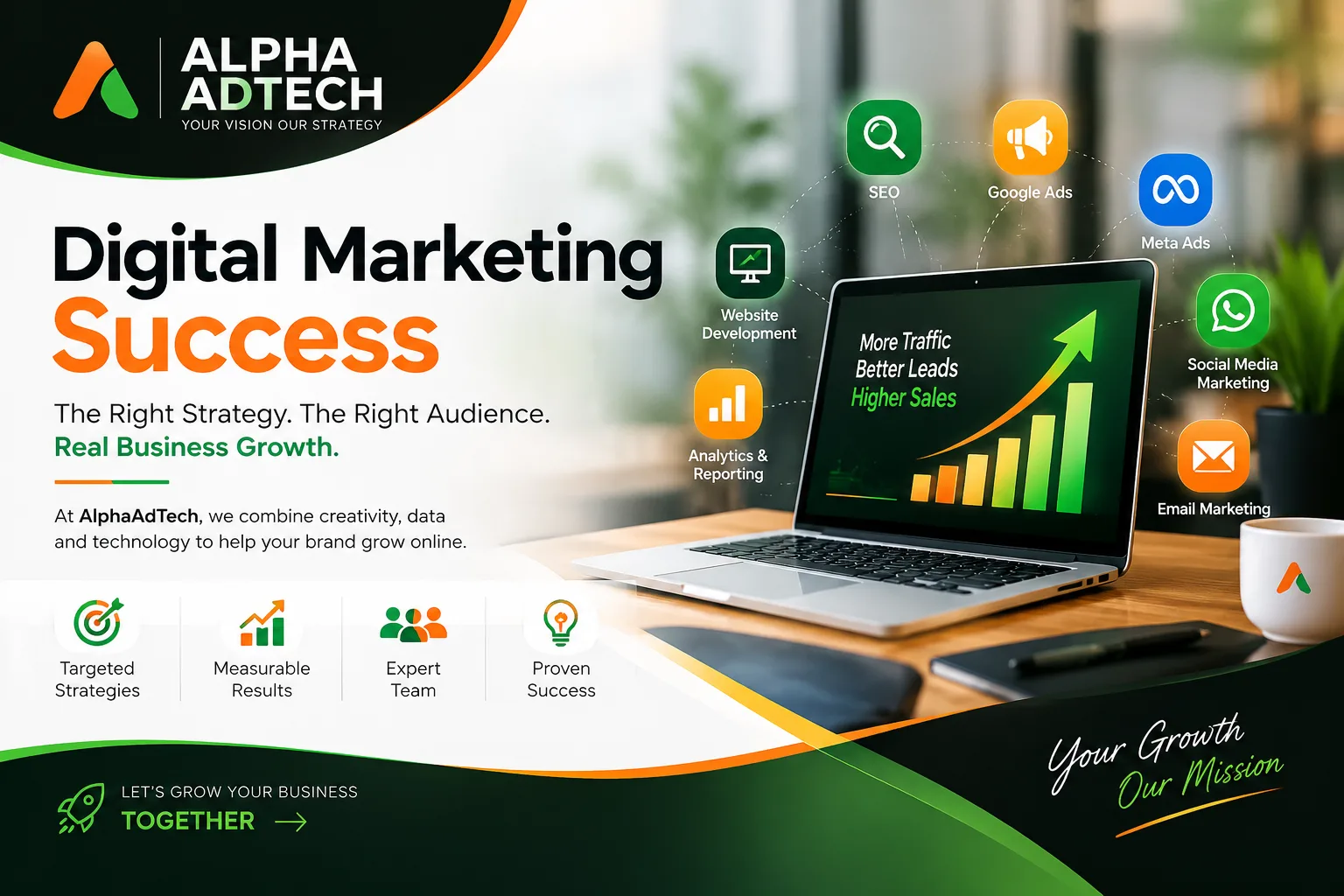
Introduction
The creation of an online presence for a business cannot be accomplished just by establishing an online trade and publishing social media posts. Customers can engage in a company through search engines, social networks, the company’s site, emails, messengers, reviews, online advertising, and much more.This makes strategic planning essential.
A business may have products or services but still find it hard to get steady questions when the marketing activities of the business are not linked. For example an advertising campaign may bring visitors to a designed landing page while the website may attract free traffic but does not show a clear way to convert. A successful marketing approach connects these activities.
The goal of Digital marketing success should be wider, than simply getting visibility. Businesses should want to pull in the audience state a clear value proposition create trust produce qualified opportunities and use marketing data to make better choices. This guide shows how businesses can build a strategy pick the right channels, track results and set up a lasting growth system.
Question Types
People searching for information about digital marketing success generally have different questions depending on their objectives.
Informational Questions
These users want to understand concepts before taking action.
Examples include:
- What is digital marketing success?
- How does online marketing work?
- Why is digital marketing important?
- Which digital marketing channels are most effective?
- How can a business improve its online presence?
Commercial Questions
These users are comparing strategies, agencies, tools, or services.
Examples include:
- Which Digital Marketing Strategy is best for a small business?
- How much should a business spend on digital marketing success?
- Which channels generate the best leads?
- How can businesses improve Digital Marketing ROI?
- What makes an Effective Digital Marketing campaign?
Transactional Questions
These users are closer to taking action.
Examples include:
- How do I hire a marketing agency?
- Which services can help online leads grow?
- How do I start a marketing campaign?
- What strategy can help online sales grow?
Understanding these question types helps marketers create content and campaigns that connect with users at every stage of the buying journey.
These question types help marketers adjust their messages for each stage so the content feels personal as if it was made just for the person reading it.
What Is a Digital Marketing Strategy?
Digital Marketing Strategy is a plan that explains how a business will use channels to reach specific marketing and business goals . I believe Digital Marketing Strategy should start with business goals and audience research not with platforms.
For example, a business might want to:
- Increase qualified leads
- Generate ecommerce sales
- Improve brand awareness
- Enter a new geographic market
- Increase website traffic
- Reduce the cost of getting new customers
- Make sure existing customers keep coming
Once the objective is set marketers can figure out which channels and tactics make sense to use. A strong plan must also clearly state the performance indicators the budget, who is responsible, for what the schedule and how results will be reported. If these parts are missing companies might end up spending money on things without being able to tell which ones are really helping the business grow.
Why Digital Marketing Matters for Business Growth
I have seen how the internet changes how customers find and judge businesses. Search engines help people locate products and services. Social media shapes awareness and engagement for customers. Websites give information that can sway purchasing choices for businesses.
Digital marketing success, for Business Growth can support this customer journey by linking marketing actions. I believe Digital Marketing success helps customers and businesses connect.
For example a potential customer may find a company via Google Search visit its website read an article see a retargeting advertisement and finally contact the business. The internet and digital marketing make this simple.
This means businesses should view marketing as a customer journey instead of a set of isolated campaigns. Customers see the whole journey and businesses benefit.
A well-planned strategy can help businesses:
- Reach specific audiences
- Build brand visibility
- Generate qualified leads
- Support customer research
- Increase website conversions
- Retain existing customers
- Measure marketing performance
- Identify profitable channels
However, marketing does not automatically create growth. Product quality, pricing, customer service, market demand, competition, and sales processes also influence business results.
Core Elements of a Winning Digital Marketing Strategy
A Successful Digital Marketing Strategy usually combines several components based on the company’s goals and audience.
Search Engine Optimization
SEO helps businesses improve their organic visibility in search engines. Important areas include technical SEO, keyword research, content quality, internal linking, local SEO, ecommerce SEO, and website architecture.
SEO can be particularly valuable for businesses that want to build sustainable search visibility over time. However, it should not be treated as an instant traffic solution.
Paid Advertising
Google Ads, Meta Ads, and other advertising platforms can provide targeted opportunities to reach potential customers.
Paid campaigns require careful attention to:
- Audience targeting
- Keyword selection
- Ad messaging
- Landing pages
- Budget allocation
- Conversion tracking
- Campaign optimization
A campaign that generates many clicks but few qualified enquiries may need changes to targeting, messaging, landing pages, or the offer.
Content Marketing for Digital marketing success
Content marketing helps Digital marketing success businesses answer customer questions and demonstrate expertise.
Useful formats include:
- Blog articles
- Guides
- Case studies
- Videos
- Infographics
- Research
- FAQs
- Industry reports
Content should be created for a clearly defined audience and should provide information that is genuinely useful.
Social Media Marketing
Social media can help people know about things get involved, build groups and run paid ads.
The best platform depends on the people who use it. A business that sells to businesses might focus on professional places where people share work-related information and learning materials while a brand that sells to regular people might use more picture-based platforms.
Just posting often does not mean social media will be successful. The content needs to be important, to the people who see it the people who follow should be the ones the designs need to be good the posts should be regular and there should be clear ways for people to take action.
Email and WhatsApp Marketing
Email marketing helps businesses build relationships, with customers and stay in touch with people who are already using their products or services. WhatsApp can also be used to communicate with customers send notifications handle questions and run marketing campaigns—only when the customer has given permission.
These channels become more effective when messages are relevant, timely, and based on appropriate customer consent and communication practices.
Building an Effective Digital Marketing Plan
An Effective Digital Marketing plan should start with research.
Step 1: Define Business Objectives
Start with measurable objectives.
Instead of saying:
“We want more online visibility.”
Use a measurable objective such as:
“Increase qualified website enquiries by 25% over the next six months.”
The second objective gives the marketing team something concrete to measure.
Step 2: Understand the Target Audience
Research:
- Customer needs
- Pain points
- Search behavior
- Buying motivations
- Geographic location
- Preferred platforms
- Common objections
- Decision-making process
Customer research can prevent businesses from spending heavily on audiences that are unlikely to convert.
Step 3: Analyze Competitors
Competitor research should examine:
- Search visibility
- Website structure
- Content
- Advertising messages
- Social media activity
- Offers
- Customer reviews
- Conversion processes
The goal is not to copy competitors. It is to identify opportunities to differentiate the business.
Step 4: Select Marketing Channels
Not every business needs every channel.
| Channel | Primary Purpose | Useful For |
| SEO | Organic visibility | Long-term search acquisition |
| Google Ads | Paid search | High-intent searches |
| Meta Ads | Paid social | Awareness and lead generation |
| Social Media | Engagement | Brand and community building |
| Retention and nurturing | Existing prospects/customers | |
| Content Marketing | Education | Trust and organic discovery |
| Communication | Enquiries and customer engagement |
Channel selection should depend on audience behavior and business objectives.
Step 5: Create the Offer and Message
A campaign needs a clear reason for customers to take action.
An offer could include:
- Free consultation
- Product demonstration
- Downloadable guide
- Limited-time promotion
- Free audit
- Trial
- Consultation request
The message should clearly communicate the problem being addressed and the value offered.
How to Improve Digital Marketing ROI
Digital Marketing ROI evaluates whether the spending on marketing activities generates enough value; in particular, the formula is dependent on the company’s business model and cost-accounting procedures.
The simplest way to calculate the return is to take the amount of profit or revenue received from the marketing campaigns and divide it by the amount spent on them; in addition to this consideration, companies should take into account gross margin, customer lifetime value, sales costs, and the challenges of attribution.
To improve performance:
- Track conversions accurately
- Remove poorly performing campaigns
- Test landing pages
- Improve audience targeting
- Refine ad messaging
- Improve lead qualification
- Monitor customer acquisition cost
- Compare channels
- Analyze customer lifetime value
For example, a campaign producing 500 leads may appear successful until the business discovers that only a small percentage are qualified. Lead quality therefore matters alongside lead volume.
Measuring Digital Marketing Success
Measuring digital marketing success requires selecting metrics that match business objectives.
| Objective | Useful Metrics |
| Increase organic visibility | Organic clicks, impressions, relevant rankings |
| Generate leads | Qualified leads, conversion rate |
| Increase sales | Revenue, transactions, conversion rate |
| Improve advertising | CPA, ROAS, conversion rate |
| Build awareness | Reach, branded searches, engagement |
| Improve retention | Repeat purchases, retention rate |
| Improve website performance | Engagement, conversions, landing-page performance |
No single metric can explain the entire performance of a marketing program.
For SEO, for example, rankings can be useful but should be considered alongside organic traffic, conversions, qualified leads, and revenue where measurable.
The Role of Data and Analytics
Data helps marketers identify what is working and where improvements are required.
Analytics platforms can provide information about:
- Traffic sources
- User behavior
- Landing pages
- Conversions
- Campaign performance
- Device usage
- Geographic patterns
- Customer journeys
Search Console can provide valuable information about a website’s search visibility, including queries, impressions, clicks, and search performance.
The important point is to turn data into decisions.
If one landing page receives significant traffic but has a low conversion rate, marketers can investigate the page’s messaging, user experience, offer, form, trust signals, or traffic relevance.
Common Mistakes That Limit Digital Marketing Success
Businesses frequently make avoidable mistakes when developing online campaigns.
Using Every Marketing Channel
Being active everywhere does not necessarily improve results. A smaller number of well-managed channels can be more effective.
Focusing Only on Traffic
Traffic is useful, but irrelevant traffic may not contribute to revenue.
Ignoring the Website
I have seen this happen. Advertising and social media campaigns often send users to websites. If the website is slow, confusing, outdated or difficult to navigate the performance of the campaign can suffer.
Publishing Low-Value Content
Large amounts of repeated material do not automatically establish authority. Content should serve an audience and provide useful information.
Not Tracking Conversions
Without conversion tracking businesses may find it difficult to know which campaigns bring business outcomes. Conversion tracking shows which campaigns truly work.
Expecting Immediate Results From Every Channel
SEO and organic content can take a while to grow. Paid ads can bring in traffic quickly but successful results still need testing and improving. SEO and organic content can take a while to grow. Paid ads can bring in traffic quickly but successful results still need testing and improving.
How to Create a Successful Digital Marketing Strategy for Long-Term Growth
Long-term digital marketing success requires continuous improvement rather than a one-time campaign.
Businesses should establish a regular cycle:
Research → Plan → Launch → Measure → Analyze → Optimize → Repeat
This process helps marketing teams react to how customersre acting and how campaigns are doing. For example if research, on keywords shows more people want a service the company might make a special landing page and related content. Digital marketing success If ad data shows one group of people buys easily the money spent on ads can be looked at again.
This approach makes marketing more evidence-based.
How AI Can Support Digital Marketing
Artificial intelligence can assist marketers with tasks such as:
- Research organization
- Content ideation
- Data analysis
- Audience segmentation
- Workflow automation
- Ad creative variations
- Customer support
- Reporting assistance
However, AI-generated material should not be treated as automatically accurate or authoritative. Human review remains important, particularly for factual claims, industry-specific information, brand messaging, and customer-facing content.
AI can accelerate workflows, but strategy, expertise, verification, creativity, and business judgment remain important.
Frequently Asked Questions
What is digital marketing success?
Digital marketing success means reaching business goals using online marketing efforts. For businesses this could mean getting more qualified leads boosting sales increasing revenue keeping customers longer building brand awareness or making customer acquisition faster and more cost-effective.
What is the most important Digital Marketing Strategy?
I have seen that no single Digital marketing strategy works for every business. Digital marketing success right strategy depends on the target audience, industry, business model, competition, budget, geographic market and objectives.
How does Digital Marketing success for Business Growth work?
From my experience this can help businesses reach audiences raise awareness generate leads help sales strengthen customer relationships and measure marketing activities. The results depend on the quality of the strategy and, on business factors.
What makes a Successful Digital Marketing Strategy?
I think a Digital Marketing Strategy should have objectives, a known audience, the right channels, useful messages, measurable KPIs, conversion tracking and a plan, for constant improvement. Digital Marketing Strategy works best when it is built on these foundations for Digital marketing success .
How can a company improve Digital Marketing ROI?
Businesses can boost the return on investment, for marketing by making sure they track conversions correctly. They can also do a job of reaching the right people. Improving the pages where visitors land’s important too. Cutting down on money spent where it doesn’t work helps. Testing campaigns is useful. And putting money into the channels that bring in good customers is a smart move.
Is SEO important for digital marketing?
A executed SEO campaign can play a key role, in any online marketing effort because it helps companies gain organic reach. How helpful SEO is depends on how much the target audience relies on search engines when looking for information, products or services.
How long does it take to achieve digital marketing success?
There is no time period that applies to everyone. Paid advertising can start showing results but SEO, content marketing, brand building and customer retention efforts can take more time to develop and show real results. There is no time period that applies to everyone. Paid advertising can start showing results but SEO, content marketing, brand building and customer retention efforts can take more time to develop and show real results.
Should small businesses invest in digital marketing?
Digital marketing success can be useful for businesses when the digital marketing plan fits the customers and the budget. I have seen small businesses thrive when digital marketing is tailored to the people they serve and the money they have. Starting with a set of channels is often more practical, than trying to manage every platform at the same time.
Conclusion
Digital marketing success does not depend on luck. It performs better when there is a clear and well-executed plan on the platform. This involves using strategies like advertising, promotion and others.. Achieving success is not something that can be done with just one platform or one solution. It is important to build a foundation, in strategy. This strategy should match what the company expects and also take into account how the audience behaves.
Good digital marketing success means creating content thats useful and relevant. It means choosing the channels—, like SEO, Google Ads, Meta Ads, social media, email or messaging platforms—based on where your audience spends time. It’s not about being. It’s about being where it matters.
A strong digital marketing success program must change over time. What works today might not work tomorrow. That’s why testing is important. You should try messages offers and different channels. When something isn’t doing well you review it. When something works you scale it— with data in hand.
At the heart of marketing success is value. You must give your customers something something something worth their attention. Then you use the data to make choices. Smart businesses don’t guess. They use information to guide their decisions.
Companies that focus on content, targeted messaging, strong websites, accurate tracking and constant improvement are the ones that win. These companies build trust. They grow steadily. They don’t rely on short-term tricks. They build a lasting presence that supports long-term business growth.